A cause for optimism
CRISPIN HULL COLUMN


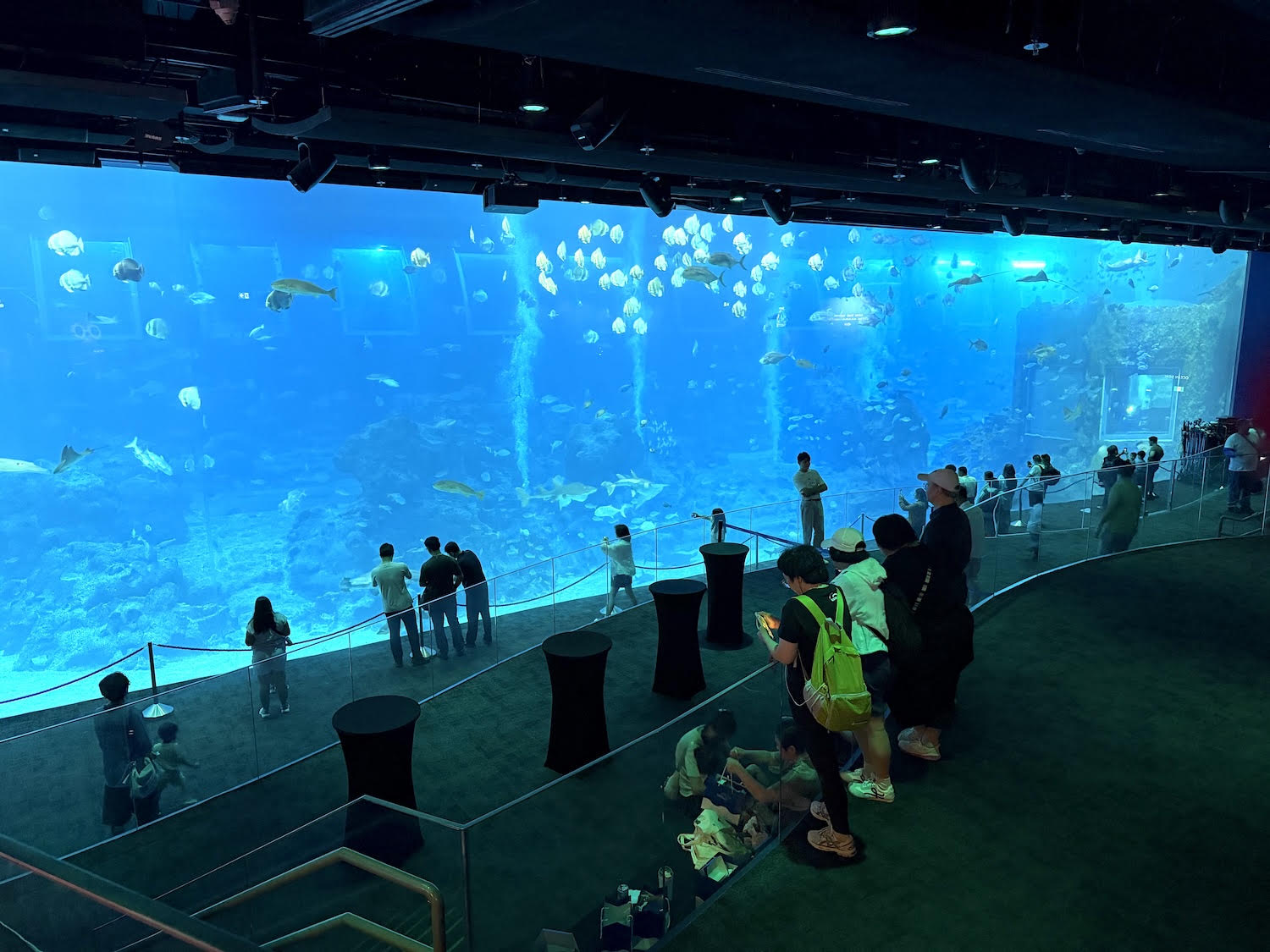
The Singapore Oceanarium is an engineering marvel.
It holds 45 million litres of water (18 Olympic pools) across 22 displays. It also has a 36m by 9 m glass window through which you can see sharks, stingrays and other large fish in the open ocean.
It is part of Resorts World Sentosa, a site in Sentosa, an island off the southern end of Singapore island, full of entertainment places that has a total revenue of about $800 million a year.
It does a valuable job in exposing people, especially the young, to the marvels of the undersea world, housing 100,000 creatures.
Alas, many of the species are endangered. It supports a range of conservation projects, especially propagating invertebrates.
Meanwhile, above water, a short way away in the Singapore Strait, you can see hundreds of oil tankers that bring crude oil from the Middle East and take refined oil products to the rest of the world, particularly to Australia. It is a weird slice of the global economy.
In one small area we see an organisation that sees value in presenting the natural world to people and in conservation, and just across the way we see the vehicles of the destruction of those very ecosystems. In one slice of the economy there are people being paid to engage in the conservation of biodiversity and close by in another, people are being paid to move fossils fuels to places where they will be burned to add to the carbon in the atmosphere that may well result in the extinction of us all.
Our imaginations find it hard to cope with that contradiction, and so does our economics. It made me recall a lecture given earlier this year by Andrew Leigh, the Assistant Minister for Productivity, Competition, Charities & Treasury, on the “Economics of Human Extinction”.
Leigh argues that traditional economics, grounded in policy responses based on cost-benefit analysis, has no way of dealing with the prospect of human extinction.
Economics is good at assessing costs against benefits or detriments. Investors can work out risk and expected gains and losses and come up with an answer of what amount is reasonable to invest to ensure those gains or avoid those losses.
The equation is fairly simple. Multiply the percentage risk of an event by the cost of the risk and you get the reasonable cost of paying to avoid that event. If the chance of being burgled is five per cent a year and the cost of the burglary is $100,000, it pays to spend $2000 to avoid that loss – either in an insurance premium or in added security.
But if the event is human extinction, there is no possibility of repairing the damage or absorbing the loss. There is no assessing the cost of the risk. Theoretically, the cost is infinite. Theoretically, the price you should pay to avoid that risk is also infinite, and therefore not countenanced.
The possibility of extinction before 1945 was only because of natural events: say an asteroid hitting earth or massive volcano eruptions; and rare pandemics.
Since then, human-caused extinction has been added as a possibility: nuclear war; climate change; pandemics; and now artificial intelligence. AI, of course, is multiplying the risks of nuclear and pandemic extinction because AI can provide the wherewithal for people to make nuclear weapons and to create pathogens which are at once more transmissibile, more lethal, and more resistant.
Without human intervention nature kept these characteristics apart: people became more easily resistant to highly transmissible pathogens and highly lethal pathogens were less transmissible.
With AI the profit motive is geared to make it more powerful and more profitable and is less concerned about making it safe.
Leigh says, “Economics has devoted a lot of attention to growth, yet paid far less attention to survivability. Modern markets reward capability more strongly than safety.”
In the past, economic growth increased prosperity and well-being and increased resiience against threats like pandemics, and occupational and general safety hazards.
Public health and safety measures increased with affluence. Now with AI, economic growth is exposing humans to greater threats to our existence
It is enlarging the ways in which humans can harm or even destroy themselves. Leigh argues that the problem is compounded because, although the cost of extinction will be borne by all, not all are willing to contribute to avoiding it and not all nations and corporations are willing to forsake immediate economic benefit for long-term security.
President Donald “Drill, Baby, Drill” Trump wants his nation and his corporate mates to continue to make greater immediate profits from the burning of fossil fuels. One Nation in Australia says we should abandon net-zero-carbon-emission policies. The Coalition has spinelessly followed suit.
Conventional economics can deal with it only if you take the extinction element out of it up to a point. If you calculate that the gain in saved electricity costs by installing solar and a battery is greater than the cost of the solar installation over its lifetime, then people will take it up.
Not many, and certainly not enough, will do so to avoid the threat of extinction, or even the long-term threat of an unbearably hot planet.
That cost is selfishly and immorally shifted to future generations. Morality and economics do not mix.
Seeing the juxtaposition of the oceanarium and the fossil fuel chokepoint in Singapore, however, is cause for some optimism.
The awe and wonder you can see in people’s faces in the oceanarium is bound to inspire some pushback against those who would heat the ocean so that species go extinct.
Including those species on land, like humans, who depend on the ocean.
And the recent disruption in oil supplies through the Strait of Hormuz to the refineries of Asia might make them think and act more against dependency on fossil fuels. Even conventional economics can
deal with that.
It would be better, however, if the economics of extinction would encourage us collectively to rein in the private pursuit of massive wealth and power by multi-billionaires that threatens us all.
This article first appeared in The Canberra Times and other Australian media on 14 July 2026.
www.crispinhull.com.au
Crispin Hull is a distinguished journalist and former Editor of the Canberra Times. In semi-retirement, he and his wife live in Port Douglas, and he contributes his weekly column to Newsport pro bono. The opinions and views in this column are those of the author and author only and do not reflect the Newsport editor or staff.